PHP Router Dual Compatibility Documentation
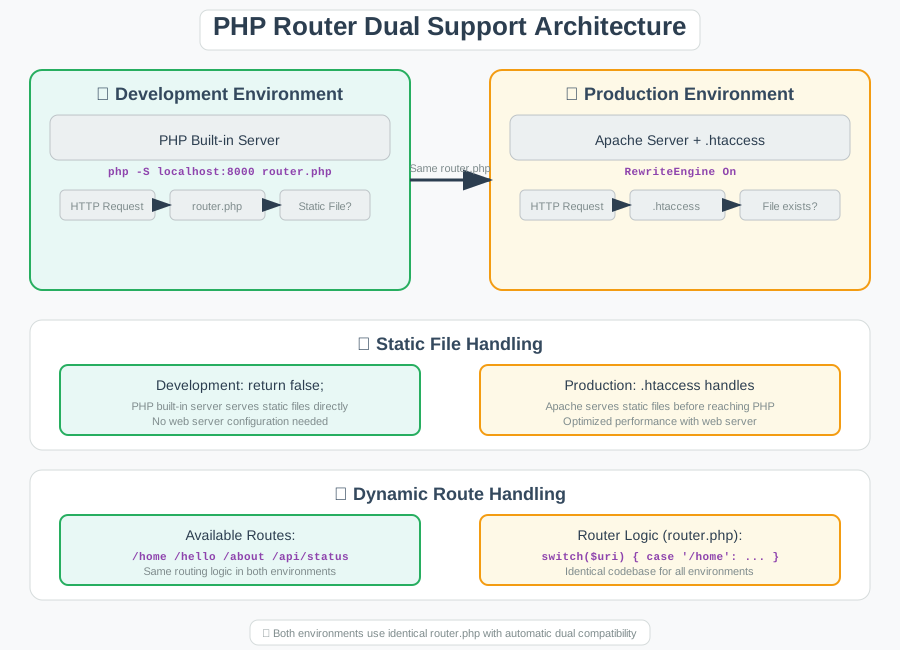
This PHP router is designed with dual compatibility to work seamlessly in both development and production environments without code changes.
🎯 Core Concept
The router automatically detects its environment and adapts its behavior:
- Development: Works with PHP's built-in development server
- Production: Works with Apache + .htaccess for clean URLs
- Same Code: No modifications needed between environments
🔧 Development Environment
Setup
# Start the PHP built-in development server
php -S localhost:8000 router.php
How it Works
In development mode, the router uses PHP's built-in server capabilities:
- All requests are routed through router.php
- Static files are detected using is_file()
- When a static file is requested, return false; lets PHP serve it directly
- Dynamic routes are handled by the switch statement
Static File Handling
// Check if it's a static file (needed for PHP built-in server compatibility)
$file = __DIR__ . $uri;
if (is_file($file)) {
    return false; // Let PHP's built-in server handle static files
}
✅ Benefits: Quick setup, no server configuration, perfect for rapid development and
testing.
🚀 Production Environment
Setup Requirements
- Apache web server with mod_rewrite enabled
- AllowOverride All in virtual host configuration
- .htaccess file in document root
Apache Configuration
# Enable mod_rewrite
sudo a2enmod rewrite
sudo systemctl restart apache2

# In your virtual host or apache2.conf:
<Directory /var/www/html>
    AllowOverride All
    Require all granted
</Directory>
.htaccess Configuration
RewriteEngine On

# If the requested file doesn't exist AND the requested directory doesn't exist
# then route the request to router.php (for dynamic routes)
RewriteCond %{REQUEST_FILENAME} !-f
RewriteCond %{REQUEST_FILENAME} !-d
RewriteRule ^(.*)$ router.php [QSA,L]

# For all other cases (when files or directories DO exist)
# serve them as-is without rewriting (static files, existing directories)
RewriteRule ^(.*)$ - [QSA,L]
How it Works
In production mode, Apache handles the routing:
- Apache checks if the requested file exists
- If it exists (static file), Apache serves it directly
- If it doesn't exist, .htaccess routes to router.php
- The return false; code never executes in production
✅ Benefits: Better performance, proper web server handling, production-ready clean
URLs.
📊 Environment Comparison
| Aspect | Development (PHP Server) | Production (Apache + .htaccess) |
|---|---|---|
| Server Command | php -S localhost:8000 router.php | Apache virtual host |
| Static File Handling | PHP checks file existence, returns false | Apache serves directly via .htaccess |
| URL Routing | All requests to router.php | Only non-existing files to router.php |
| Performance | Good for development | Optimized for production |
| Configuration | Zero configuration | Requires mod_rewrite + .htaccess |
📁 File Structure
project-root/
├── router.php          # Main router logic (works in both environments)
├── index.php          # Entry point for .htaccess (optional)
├── .htaccess          # Apache rewrite rules
├── assets/
│   ├── style.css      # Stylesheet
│   ├── demo-image.svg # Demo image
│   └── docs.php       # This documentation
└── README.md          # Project documentation
🔄 Request Flow
Development Environment Flow
- Browser requests /hello
- PHP built-in server routes to router.php
- Router checks if it's a static file
- Not a static file → processes route in switch statement
- Returns HTML response
Production Environment Flow
- Browser requests /hello
- Apache checks if /hello file exists
- File doesn't exist → .htaccess routes to router.php
- Router processes route in switch statement
- Returns HTML response
🛠 Available Routes
- /home - Home page with route listing and architecture diagram
- /hello - Hello page with optional name parameter
- /about - About page with technical details
- /api/status - JSON API endpoint
- /assets/* - Static files (CSS, images, etc.)
🚨 Troubleshooting
Common Issues
⚠️ 404 on static files in production:
Check that Apache has mod_rewrite enabled and AllowOverride All is set for your directory.
⚠️ Routes not working in production:
Verify .htaccess file permissions (644) and that it's in the correct directory (document root).
⚠️ 500 Internal Server Error:
Check Apache error logs: tail -f /var/log/apache2/error.log
Testing Both Environments
# Test development server
php -S localhost:8000 router.php
curl http://localhost:8000/hello

# Test production (assuming files in /var/www/html/)
curl http://localhost/hello
✨ Key Benefits
- Zero Code Changes: Same router.php works in both environments
- Seamless Development: Quick setup with PHP built-in server
- Production Ready: Clean URLs and proper static file handling
- Automatic Detection: Environment-aware behavior
- Performance Optimized: Static files served efficiently in production
🎓 Learning More
This dual compatibility pattern is useful for:
- Building prototypes that can scale to production
- Teaching PHP routing concepts
- Creating portable PHP applications
- Understanding web server request handling